Find the thing that keeps going wrong
The brief has changed, but someone is still working from yesterday's version. A useful note has disappeared into a chat. One take was approved and another ended up in the export. Before choosing a model or connecting any tools, we need to understand where this happens and what the next person needs to know. A small, recurring problem is often a good place to begin.
Take a scene breakdown that has already been checked. An agent could turn it into draft questions for production and art, showing which scene each question comes from. Anything unclear should remain a question, rather than become an invented answer. Then the crew can try it: are these the right questions, is anything missing, and can someone act on them? That gives us something concrete to judge before building more.
Some jobs just need a rule
Renaming files or checking that a form is complete can follow a fixed rule. Working out what's unclear in a brief takes interpretation. Anthropic's guidance makes a similar distinction between predefined workflows and agents that choose their own steps and tools, and recommends starting with simple approaches. That distinction helps us decide how much freedom a particular production task needs.Anthropic: Building effective agents — architectural principles
Sometimes a decent form and a checklist are enough. When the work needs interpretation, an agent can suggest an answer and point to the material behind it. Add another agent only when it's clear what that agent contributes and who brings the results together. Three agents working from three different versions of a brief can give the crew more confusion to sort out.
Where did that answer come from?
The person checking an agent's work needs to know which material it used, what it's suggesting and what it couldn't find. If two notes contradict each other, show both and ask for a decision. A confident sentence that quietly combines them can hide the very issue someone needs to resolve. Useful output gives the reviewer enough context to approve the work or send back a specific correction.
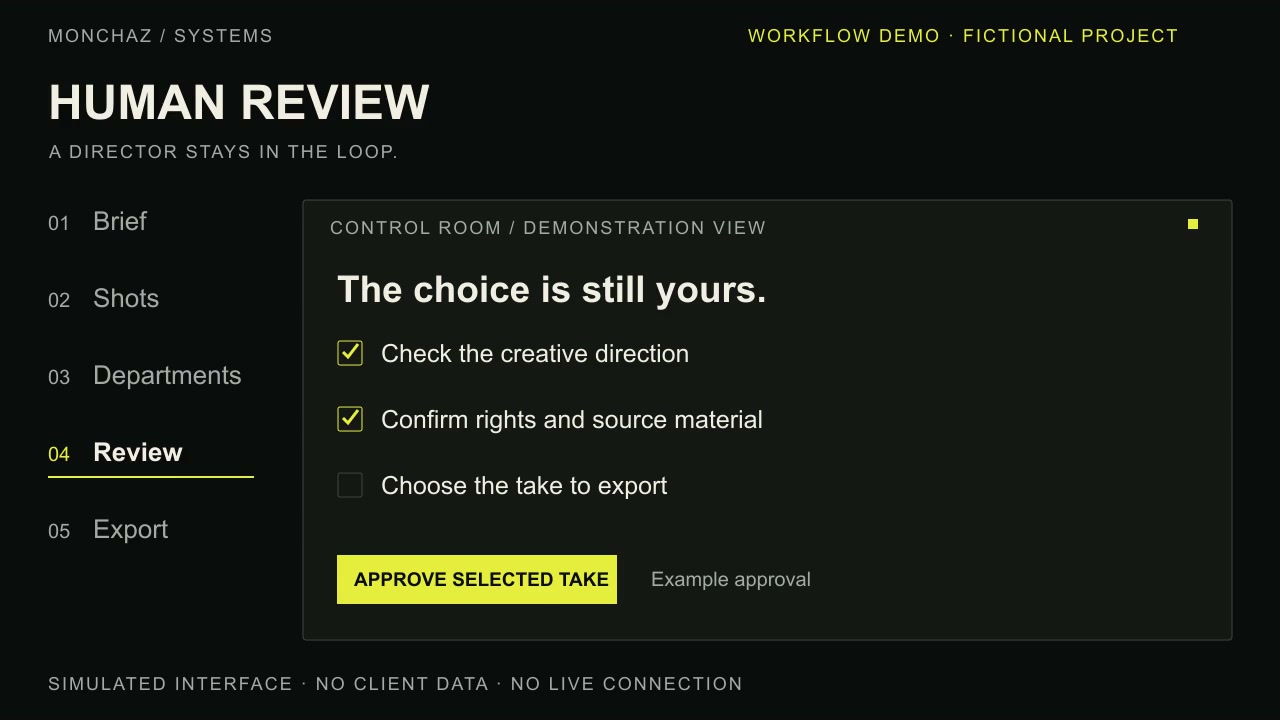
Our Control Room demonstration shows how we bring department drafts and next steps together. It is adapted from our internal interface, using fictional project information; visitors aren't seeing a live production database. In the video workspace, the same idea keeps a chosen take alongside its review through export. We want to be able to see what was approved even after several more versions have arrived.
Before anything is sent, booked or published
An agent can draft a message, but the person approving its delivery needs to see the message and the recipient. The same goes for booking a supplier or publishing a film: show the actual action, the version involved and the relevant details. Decide where those checks belong while designing the process. An approval button is of little use if nobody can tell what happens after they click it.
OpenAI's practical guide to building agents recommends human intervention after defined failure thresholds and for sensitive or high-impact actions. Applied to a production, that could mean stopping when a result can't be checked or before the next step commits the crew to something outside the system. This is one way to put the guidance into practice. The whole process still needs testing; adding a button doesn't settle the question of reliability.OpenAI: A practical guide to building agents
Does it actually make the crew's day easier?
A pilot needs to count the time spent checking and correcting the work, too. A document made in seconds may be little help if it takes an hour to fix. Track missing details, wrong versions and work that comes back for another pass. Try changing the input, removing a file or rejecting a suggestion. Keep a way to return to the previous process if the experiment doesn't hold up.
A worthwhile first result can be quite small: everyone knows which brief to use, which version was approved and who needs to act next. If that keeps working over several rounds, there's a reason to take it further. The point is to give the crew more time and attention for the film. The people making it still make the choices and take responsibility for them.
Sources & further reading
These are the original sources used in the essay. Tools and their terms change, so check the current documentation before starting work. The suggestions here offer ways to approach a film; they don't guarantee a particular result.